- Allergens
- Menu
- Eating out
- Austria
Allergens A to R on the menu: what the letters mean
On Austrian menus, many dishes are followed by letters such as A, C or G. What each letter means, why I, J, K and Q are missing, and what the codes do not tell you.

6 min readEm inglês
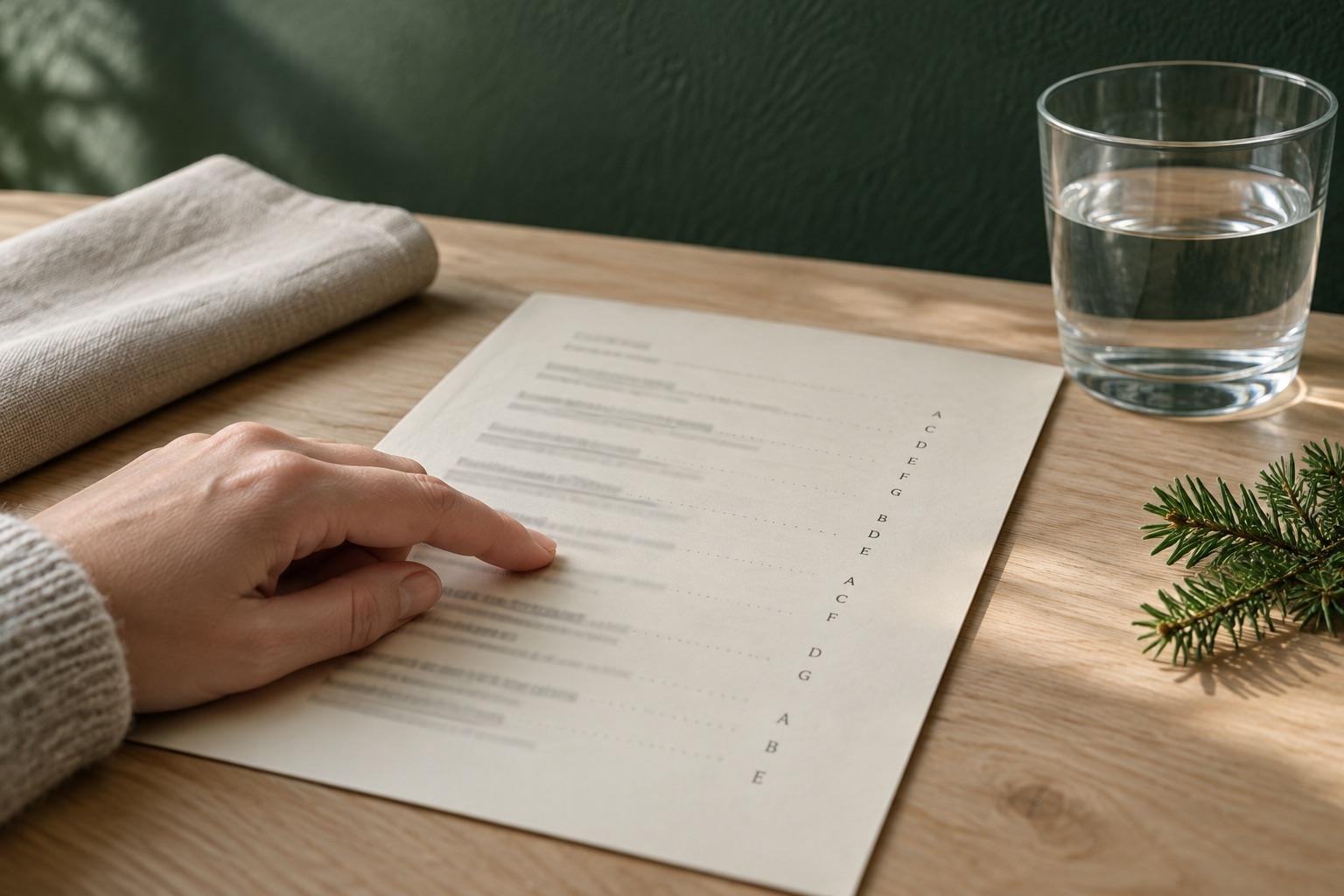
The letters after the dishes on Austrian menus are the allergen labelling: each letter from A to R stands for one of the 14 major allergens set by the EU. A means cereals containing gluten, C means egg, G means milk. The letters mean the same thing everywhere in Austria, because they are based on a recommendation from the Ministry of Health. This article explains what each letter means, where the key has to be, and what the codes do not tell you.
In short: A to R are 14 fixed codes for the 14 major allergens. They show which allergens are in a dish as an ingredient. They do not show whether traces can get in during preparation. The key has to be easy to see and close to the codes.
The 14 letters at a glance
| Letter | Allergen |
|---|---|
| A | Cereals containing gluten |
| B | Crustaceans |
| C | Egg |
| D | Fish |
| E | Peanut |
| F | Soya |
| G | Milk or lactose |
| H | Tree nuts |
| L | Celery |
| M | Mustard |
| N | Sesame |
| O | Sulphites |
| P | Lupin |
| R | Molluscs |
The letters I, J, K and Q are not used. That is not a mistake on the menu; it is how the system was set up.
What is behind the letters
The short names are brief. Some of them cover more foods than you might think at first:
- A, cereals containing gluten: wheat in all its forms, so also spelt, khorasan (Kamut), emmer, einkorn and Grünkern (green spelt), plus rye, barley and oats.
- G, milk or lactose: milk from cows, sheep, goats, horses and donkeys, and everything made from it.
- H, tree nuts: almonds, hazelnuts, walnuts, cashews, pecans, Brazil nuts, pistachios and macadamias. Peanuts have their own letter, E.
- O, sulphites: only above 10 mg per kilogram or litre. This often affects wine, dried fruit and some sauces.
- R, molluscs: mussels, oysters, snails and squid.
There are a few exceptions. For example, wheat-based glucose syrup does not have to be labelled A, and neither do cereals used to distil spirits.
Where the key has to be
The letters cannot stand on their own. According to the Ministry of Health recommendation, a key with the heading "Allergeninformation gemäß Codex-Empfehlung" (allergen information according to the Codex recommendation) has to be displayed where it is easy to see and read. That can be on the menu itself, on a table stand, a notice or an information sheet. The key has to be close enough to the codes that you can read both at the same time.
If there is no key anywhere, you can ask for it.
What the letters do not show
The codes answer one question: which major allergens are in the dish as an ingredient? There are three questions they do not answer.
Traces from preparation. If chips are fried in the same oil as breaded schnitzel, there is still no A next to the chips. Whether a dish may contain traces is voluntary information. Ask about it if it matters to you.
Allergens outside the 14. If you react to something else, such as peppers or kiwi, there is no letter for it. The only way to find out is to ask about the ingredients.
How much. An A says nothing about the amount. A dish with a pinch of flour in the sauce gets the same A as a plate of spaghetti.
And "gluten-free" on the menu?
"Gluten-free" is not the same as a missing A. A restaurant that calls a dish gluten-free has to follow an EU rule: no more than 20 mg of gluten per kilogram. AGES (Austria's national food agency) checked this in an inspection campaign in restaurants, bakeries, pastry shops and coffee houses. Of 61 samples sold as gluten-free, three were found not to comply.
For you, this means: "gluten-free" is a specific commitment that gets checked. A dish without an A, on the other hand, is only a dish without an ingredient containing gluten.
How to use the codes at the table
- Find the key. Is it on the menu or on a table stand? If not, ask for it.
- Remember your letter. For coeliac disease A, for a milk allergy G, for a nut allergy E and H.
- Read the sides and sauces too. The code next to the main dish does not automatically apply to sides listed separately.
- With a severe allergy, ask, even if there is no letter. No code answers the question about the fryer, the hotplate and the work surface.
What this article cannot do
The codes show what a restaurant declares. Whether that information is correct depends on the kitchen, and recipes change. What you eat is your decision, based on the information you get on the spot.
Frequently asked questions
Does every restaurant have to put letters on the menu?
No. A restaurant can also give the information orally, as long as a clearly visible notice points this out and trained staff give the information. That information has to be based on written documentation.
Do the letters apply in Germany too?
The 14 major allergens are the same across the EU. The letters A to R are the Austrian recommendation. Germany and other countries often use other symbols or numbers. Look for the key there.
Why do oats get an A?
Under EU rules, oats count as a cereal containing gluten. There are specially produced oats that may be sold as gluten-free. Whether that applies to a dish is something you have to ask at the restaurant.
Does G mean "lactose-free is not possible"?
G stands for milk or lactose. A lactose-free product can still be labelled G, because it still contains milk protein. With a milk protein allergy, it is the G that counts, not the lactose.
Sources
- Bundesministerium für Gesundheit (Austrian Ministry of Health): Empfehlung zur schriftlichen Allergeninformation bei nicht vorverpackten Lebensmitteln („offene Waren“), 2014 (recommendation on written allergen information for non-prepacked food)
- Wirtschaftskammer Österreich (Austrian Economic Chamber): Legende Allergeninformation gemäß Codex-Empfehlung (allergen key according to the Codex recommendation)
- AGES: Schwerpunktaktion „Gluten in glutenfreien Produkten in der Gastronomie“ (A-702-26) (inspection campaign on gluten in gluten-free products in restaurants)
- Gesundheitsministerium, verbrauchergesundheit.gv.at: FAQ Allergeninformation bei unverpackten Lebensmitteln (FAQ on allergen information for non-prepacked food)